The problem
Gallatin Farms Collective manages 5,200 acres of wheat, barley, and canola across six field blocks in south-central Montana. Their irrigation scheduling was calendar-based. Fertilizer decisions came from county extension averages, not per-field data. Two agronomists were driving 200-mile rounds every week just to spot visual stress.
Yield variance between adjacent blocks was as high as 22%. Nobody knew why. They had no sensor infrastructure and a spotty cellular signal across most of the operation.
What we did
Week one we designed the sensor architecture. LoRa gateways at each field block feed soil moisture, temperature, and canopy reflectance (NDVI) readings into an edge NixOS node every four minutes. Tailscale ties the nodes into a private mesh — no exposed ports, no VPN headaches.
Weeks two and three: TimescaleDB on the central node stores the time-series at full resolution for 18 months, then compresses. We wrote ingestion workers in Go and a lightweight alerting engine that uses per-block historical baselines to flag anomalies rather than global thresholds.
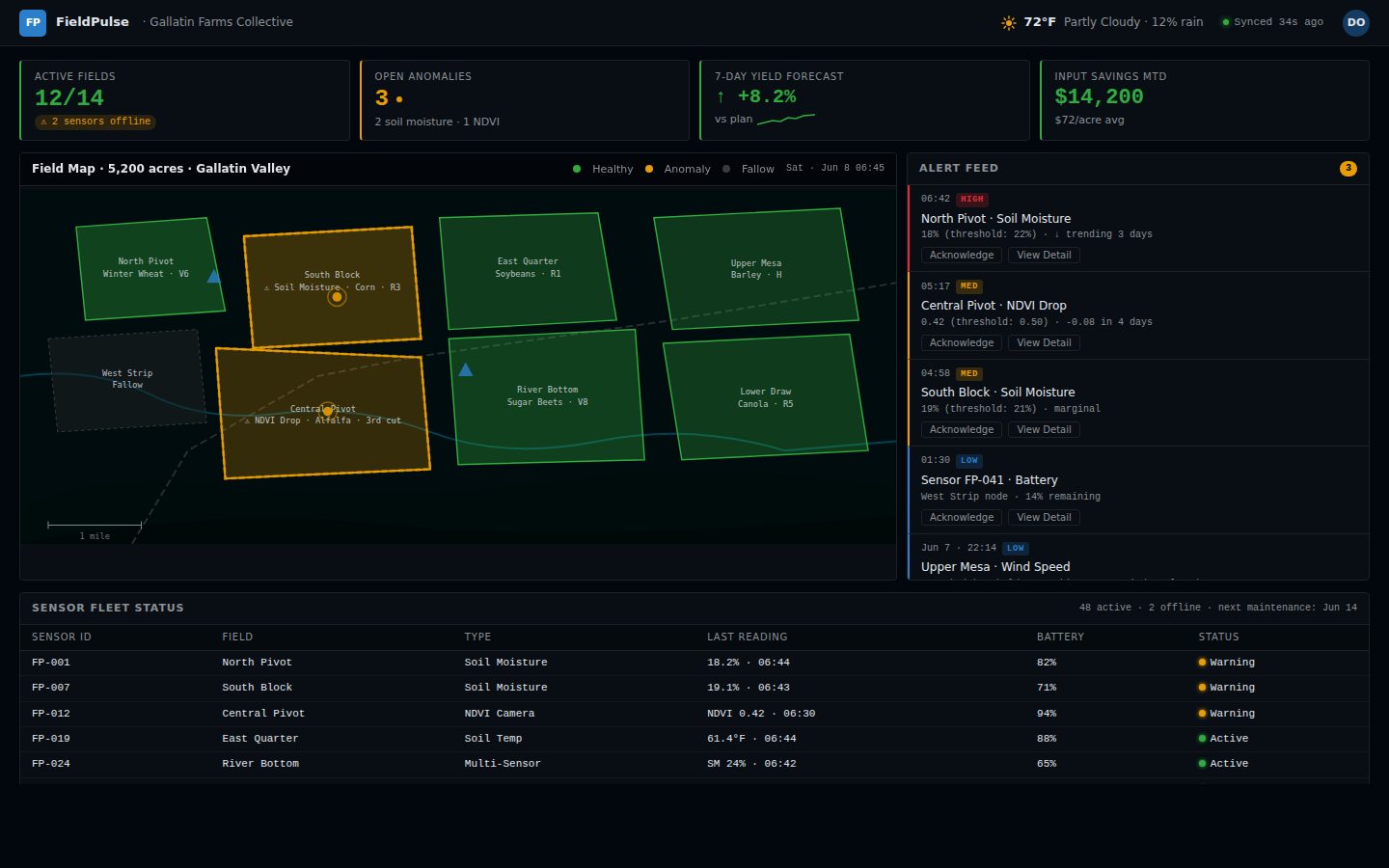
Week four we integrated NOAA forecast data and built the yield-prediction model — a gradient-boosted regressor trained on three years of county USDA records, tuned on Gallatin’s own sparse history. Grafana dashboards give each block operator a single pane: sensor health, alert queue, predicted yield delta, and recommended input adjustments.
Weeks five through seven: field hardening. Enclosures rated to −40 °F, watchdog reboots, NixOS rollbacks on bad deploys, offline edge buffering when the Tailscale uplink drops. Week eight was handoff, runbook documentation, and operator training.
Results
After the first full growing season, Gallatin’s agronomists resolved anomalies 2.1× faster — catching early-stage stress before it required expensive intervention. Fertilizer and water inputs dropped 16% cooperative-wide by targeting applications to block-level need rather than field-average estimates. Net savings came to $72 per acre across the full 5,200 acres. The two weekly scouting drives are down to one targeted visit per month.